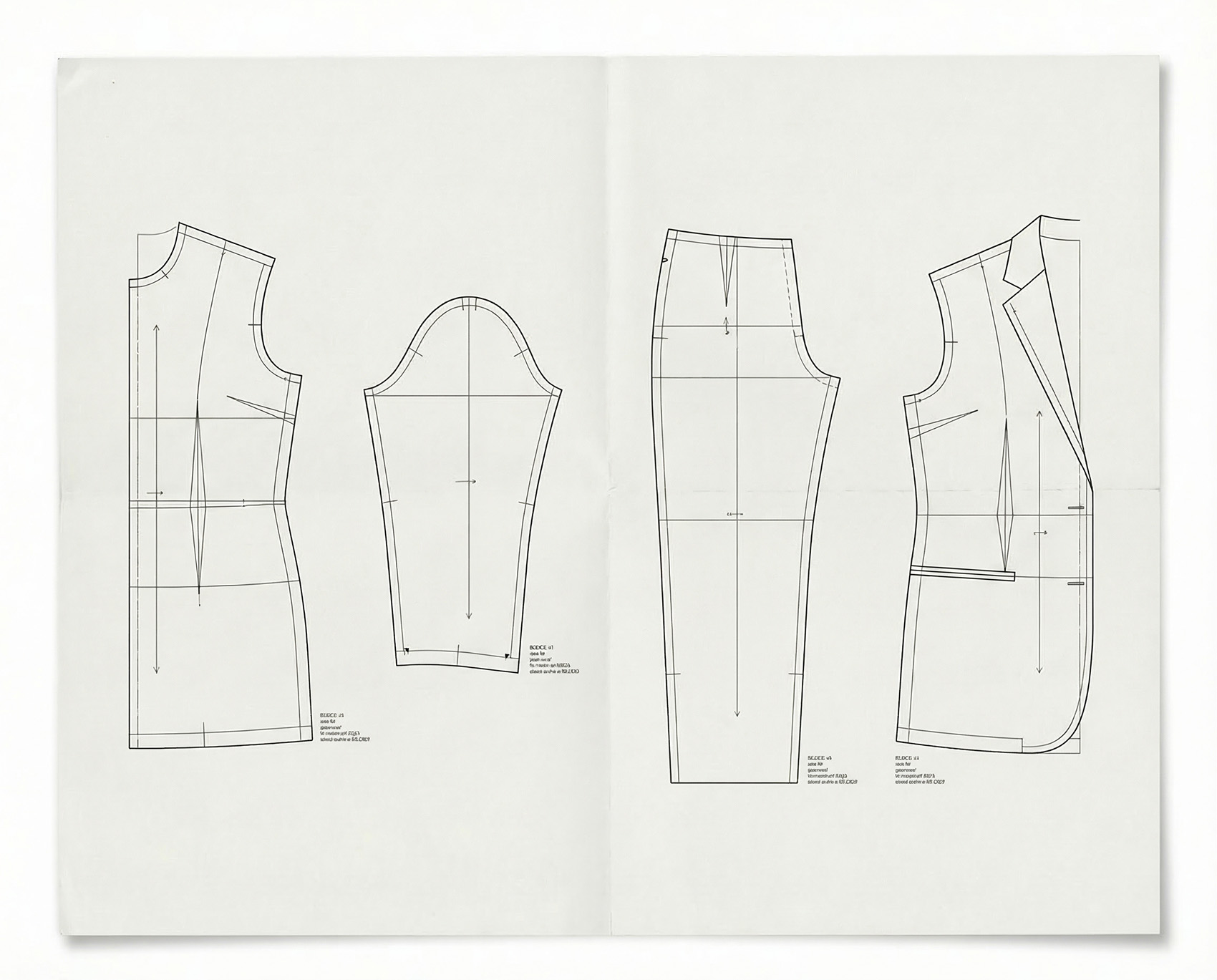
Technical breakdown
Most early-stage brands treat every new design as a standalone project. A jacket goes to the pattern maker, who drafts it from scratch. Then a shirt, also from scratch. Then a trouser. Each style is built as if the previous one never existed.
This is the primary reason brands struggle with inconsistent sizing and expensive sampling loops. Without a shared foundation, no two garments will ever fit the same way twice - even when they are the same size.
The solution is a block: a master pattern set that represents your brand’s ideal fit for a given size and category. Not a garment, not a style, but the structural geometry that every future design is built on top of.
What a block actually is
A block contains no style lines, no pockets, no decorative details. It is the precise shell that fits your fit model correctly: correct shoulder slope, correct armhole curve, correct ease for your intended silhouette. Everything beyond that is design.
When you want to develop a new shirt, you start from your shirt block and manipulate it. You add a collar, change the sleeve, move a seam. The core geometry - the part you have already spent sampling rounds perfecting - stays locked. You are no longer testing fundamentals. You are testing style.
The two consequences of not having one
Development speed. Without a block, every new style begins at zero. The first sample is not refining the design - it is trying to establish whether the basic fit works. You are spending sample rounds on geometry that should already be solved. With a verified block, that problem is already behind you.
Fit consistency. Customers return to brands because they know how they fit. If a customer buys a size medium this season and it fits differently from the medium they bought last season, the brand has a trust problem. When every style is built from the same block, that consistency is structural - it is built into the file, not dependent on memory or luck.
Building the library
A single block is not enough for a full collection. A properly maintained pattern library includes a block for each garment category you produce: bodice, sleeve, trouser, jacket. These are developed over time and refined based on fit feedback - if you consistently hear that your waistbands run tight, that correction goes into the block, and every future trouser inherits the fix automatically.
The investment is front-loaded. Developing a block requires fit sessions, measurement calibration, and time. Once it exists, it is the highest-return file in your pattern library. Every style built from it is faster, cheaper, and more predictable.
The factory relationship
When a factory has produced from your blocks before, they know how your patterns behave. They know how your seam allowances are structured, how your notch system works, and what your standards look like. That working knowledge reduces friction on every future order. Factories that are familiar with your blocks produce better first samples.
Checklist for building and maintaining your block library:
- Fit model measurements documented and version-controlled
- Base size confirmed and agreed with production partner
- Bodice, sleeve, trouser, and jacket blocks developed and approved
- Each block labelled with version, date, and fit model reference
- Grade rules built from the block, not derived separately
- Block updated each time a systematic fit correction is made across styles