Technical breakdown
In apparel manufacturing, the final cost of a garment is not primarily driven by the fabric. It is driven by the time it takes to assemble the piece. Factories operate on a minute-based costing model - every operation on every component has an assigned time value, and those minutes add up to the invoice.
This means every design decision is also a financial commitment. The brands that understand this build products that are commercially viable. The ones that do not keep receiving costing sheets they did not expect.
What drives assembly time
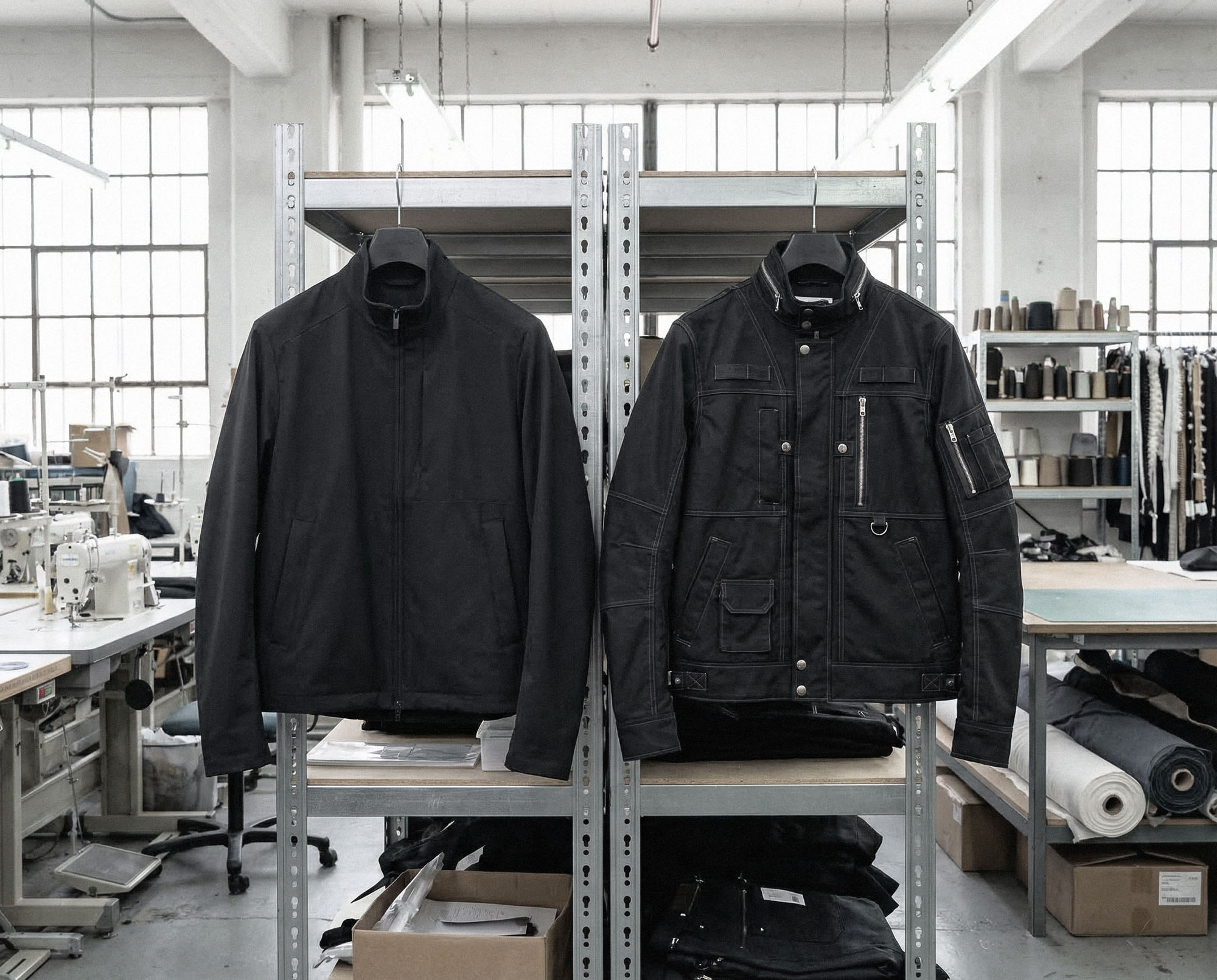
Part count. The number of pattern pieces in a garment is a reliable indicator of production cost, even before the first seam is sewn. Every piece must be cut, bundled, identified, and delivered to the right operator in the right sequence. A garment with 30 pieces involves significantly more handling time than a garment with 12 pieces producing a similar result. That difference is billed.
Construction method. An overlocked seam is fast. A French seam, a bound edge, or a flat-felled seam requires more handling, more precision, and often a machine change. When a construction method demands high-level execution, the factory charges for the skill and the time. Specifying a complex interior finish on a low-margin product is the wrong trade-off.
Alignment requirements. Any detail that requires visual matching - stripe alignment across side seams, pocket centring on a pattern, mirrored panels - forces the sewer to stop sewing and start checking. This non-sewing time is invisible in a sketch and very visible in a costing sheet. It is one of the most underestimated cost drivers in the entire design process.
Trim and hardware changeovers. A production line is most efficient when it runs through a single operation without interruption. A garment that requires 10 different hardware types forces repeated machine changes, thread re-threading, and tension adjustments across the production run. Each changeover reduces output per hour.
The question to ask before finalising a design
Before locking a technical detail, ask: does this element add enough to the product to justify what it costs to produce?
This is not a question about cutting corners. It is a question about intent. A complex seam that is visible and central to the garment’s identity is worth the cost. The same seam on an interior facing that no customer will ever see is not.
The best designs are the ones where every additional step in assembly has a clear reason - aesthetic, structural, or quality-related. Details that exist because they were not questioned during design are the ones that consistently inflate production costs without improving the product.
Designing for manufacture
Designing for efficient production does not mean designing simple clothes. It means designing with an understanding of where the cost is created and making deliberate choices about what earns its place in the construction.
Most of the time, the same silhouette can be achieved with fewer pattern pieces, a more efficient seam sequence, or a simplified trim strategy. The final garment looks identical to the customer. The production cost is substantially lower. The margin improves.
That is not a compromise. That is good product development.
Checklist before finalising technical details:
- Part count reviewed - can the same result be achieved with fewer pieces?
- Complex seam finishes justified by customer-visible value
- Alignment requirements flagged and costed before approval
- Hardware types minimised - is a single closure type sufficient across the style?
- Construction sequence reviewed for efficiency - are there unnecessary handling steps?
- All design details checked against the costing impact before the tech pack is sent